
Welcome!
Welcome to a new chapter of the Learning Dispatch. I’m Nivarni, Sales Account Executive at Microassist, and I’m excited to guide you through our newsletter’s refreshed format. Moving forward, we will focus on real-world concerns, questions, and challenges you and your peers face in training and development. You will continue to receive expert perspectives, with our team contributing deep-dive insights each month. In this issue, we begin with Kevin’s analysis of how to handle outdated or inaccurate learning content.
To add further value, we are introducing a few new elements: annotated links to articles we find inspiring, reflections and thoughts from our team, and highlighted case studies to provide practical context to the challenges we discuss. We will also include links to previous editions of the Learning Dispatch that you may find useful. We want this to be a resource that grows with you. If there is a specific topic or question you would like us to explore, please reach out – we would love to address it in a future edition. Let’s get started!
Nivarni Narayan
[email protected]
This Month’s Question
Does your training program have outdated or inaccurate learning content?
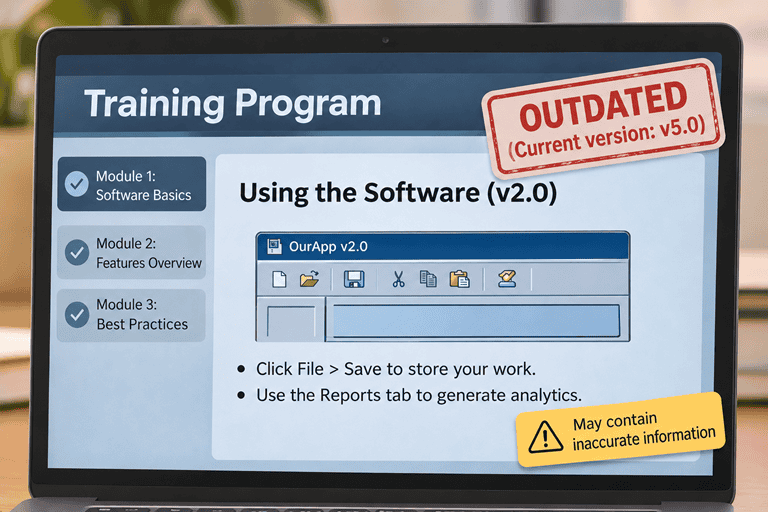
If so, you’re not alone. One of the more common issues that we’ve seen here at Microassist is that learning content often drifts out of alignment as policies, systems, processes, and source material changes. As a result, the training no longer provides accurate content and needs to be either revised or archived.
Insight by Kevin
Outdated or inaccurate learning content haunts every training program we’ve seen. Sometimes, it’s a result of keeping training in the system long past the point of usefulness. Courses, for example, that had been intended to be temporary yet were never removed. Other times, material slowly becomes out of date as regulations, policies, or software changes. The core of the training continues to be essential, but there are elements that are no longer accurate.
Each of these situations (and many others like them) have unintended consequences. The courses clutter up the learning management system and make it harder for learners to find current training. They create cognitive load as learners aren’t sure what’s relevant and what should be ignored. They undermine confidence in an organization’s learning and performance efforts, as employees doubt whether the training that they are able to access is accurate, useful, or practical.
At the same time, keeping training programs up to date takes time and money, of which there is a limited supply and a never-ending demand.
Is the gain worth the cost? There’s no ambiguity in the answer, no gray areas. When training is outdated or inaccurate, the resulting decrease in productivity and loss of employee trust damages an organization. Recovery is possible, but it takes time.
Solutions range from organizational policies for continual review and assessment to processes for retiring and updating training. And note: if you’re in a position where it’s the resources that are lacking, a trusted training partner, one who takes the time to understand and address your needs, can help.
Vantage Points
A couple of perspectives on the need to update outdated or inaccurate content.
Updating learning experiences | Australian Public Service Academy
“A good update checklist is more than an administrative task. It gives learning teams a consistent way to confirm that learning remains accurate, accessible, relevant, and aligned to agency needs. It also helps agencies avoid ‘set and forget’ learning, where material stays published.”
It’s Not Me, It’s You: The Art (and Strategy) of Sunsetting PD Programs
“Here’s the thing: What served our members well five years ago might not be serving them now.”
Inside View
Most training is not something you can simply deliver or upload once and check off your list. Maintaining training programs and materials requires ongoing time and resources. As regulations, policies, and technology evolve, organizations face challenges in keeping their training current, particularly those with large workforces or limited resources. Microassist has worked with numerous clients to develop new training and update existing offerings in response to changes in industry requirements and company policies, organizational structures, training ownership, and budget constraints.
—Kim Bahr, Senior Instructional Designer
In Practice
Facing the need to update your training courses? Microassist regularly helps organizations update their content, both on an organizational level and updating individual courses.
Take a look at how Microassist has assisted other organizations in the past. Does your organization face similar issues?
Case Study: Empowering Liquefied Natural Gas Teams Through Modernized Safety and Operations Training
The client faced the challenge of keeping critical training content current, engaging, and aligned with evolving regulations, internal policies, and operational expectations.

Explore their opportunity, Microassist’s solution, and the results.
Related Dispatches
Looking for additional insight? You might find these previous issues of the newsletter helpful.
Avoid technical debt: Does Your Training Program Have Technical Debt?
Address the multiple realities that are a part of every program: The Training Crucible, Part 1 and The Training Crucible, Part 2.
Wrapping Up
That’s all for this month. We hope you enjoy this new format. If you have any questions about the newsletter, would like to know more about what we offer, or have a project you’d like to discuss, we’d love to hear from you.
Thanks!